




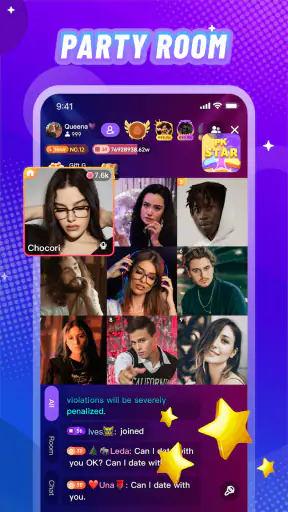




I came to Vone: Live, Video Party & Fun looking for a social app that felt more immediate than scrolling through a conventional feed. Its focus is live interaction, so the useful question is not simply whether it has a large audience, but whether it helps you move smoothly from opening the app to finding a conversation worth staying in. After spending time with it, I see Vone as a casual, video-centered social space for people who enjoy meeting others in the moment rather than carefully composing posts for later.
The app is free to install, although it includes optional purchases ranging from a few cents to more than two hundred dollars per item. That matters because the basic download is easy to try, but the social experience may encourage spending once you become involved with live interactions. Vone is rated for mature users aged seventeen and above, and I would take that seriously: it is designed for adult social discovery, not for children or for anyone expecting a tightly controlled family environment.
From opening the app to finding a live conversation
The starting condition: what kind of social need Vone suits
My best use case for Vone is a spare half hour when I want human contact without committing to a formal group, a long message thread, or a polished public post. The app belongs to the social category and comes from Vone Team, with a store rating of 4.4 from roughly 24,000 ratings. That level of interest suggests it has found an audience, but the rating alone does not tell me whether every room or interaction will match my mood.
Before opening it, I would decide what I actually want from the session. If I want a quick, low-pressure look at live activity, Vone makes sense. If I need dependable communication with friends, a private group chat is usually the better tool. If I want a carefully edited video feed, a mainstream short-video platform may feel more familiar. Vone’s appeal is the handoff from browsing into participation, and that can be exciting when I am open to meeting unfamiliar people.
A realistic example is an evening when I have finished work but do not want to watch another series alone. I open Vone, look through the live social activity, and choose something that seems welcoming rather than jumping into the first available option. That small pause is important. Live apps reward curiosity, but choosing without thinking can leave me in a conversation that is noisy, uncomfortable, or simply irrelevant.
The first steps: browsing before joining
I would treat the opening screen as a filter rather than a destination. The store summary presents Vone as a fun and efficient live social app, but the practical experience depends on how quickly I can identify the kind of interaction I want. I look for signs of energy, a topic or style that interests me, and a pace that feels manageable. A live room that is already moving quickly may be entertaining, while a quieter one may be easier for a newcomer to enter.
My advice is to spend a moment observing before contributing. This is one of the more useful habits in a live social app because the atmosphere can change rapidly. Watching first helps me understand whether people are chatting casually, performing, welcoming newcomers, or mainly interacting with one another. It also prevents the common mistake of assuming that every live space is intended for the same kind of participation.
Vone is not the sort of app I would open expecting a predictable sequence. That is part of its charm, but also a source of friction. A conventional social network gives me more control over what appears in front of me, while a live platform asks me to accept a degree of surprise. I enjoy that trade-off when I am relaxed; I dislike it when I need a specific person or topic immediately.
Moving from spectator to participant
The important handoff happens when I stop watching and decide to interact. In my experience, that decision should be gradual. I can begin with the lightest available form of participation, see how the room responds, and only then become more involved. This keeps the session comfortable and gives me time to judge the tone before sharing anything personal.
That workflow is especially useful for people who are socially curious but hesitant about live video. You do not have to approach the app as if you are entering a stage. Think of the first visit as reconnaissance: learn how conversations form, notice what gets attention, and decide whether the people present are the kind you would genuinely like to meet. The result is more rewarding than treating every room as a contest for visibility.
There is also a practical reason to avoid rushing. Live interaction has less editing than ordinary posts, and a comment or appearance can feel more exposed once it is made. I would keep early conversations general, avoid sharing identifying details, and leave promptly if the atmosphere becomes uncomfortable. That is not a criticism unique to Vone; it is the basic discipline required by any app built around meeting strangers in real time.
How the social handoffs shape the experience
Vone’s central workflow is a chain of handoffs: the app brings me from discovery to a live space, the live space brings me into contact with other users, and that contact may lead to a more sustained exchange. Each handoff can either increase the fun or create resistance. A good room makes the transition feel natural. A confusing or unsuitable room makes me feel as though I am spending effort just to find somewhere comfortable.
I found that my role matters as much as the app itself. A passive visitor may enjoy the atmosphere but leave without forming a connection. An overly aggressive participant may make others uncomfortable. The most effective middle ground is to respond to what is already happening, contribute something small, and notice whether the exchange becomes mutual. That approach gives the app a chance to work without demanding instant confidence.
For someone using Vone with friends, the handoff is different. The value comes from turning a shared moment into a live social activity rather than simply sending messages. I would agree on boundaries before inviting anyone into an unfamiliar space, especially when the session is intended to stay casual. The app is more appealing when everyone understands whether they are there to watch, talk, joke around, or meet new people.
What happens when the flow succeeds
When the sequence works, Vone feels more immediate than a normal feed. I can discover activity, assess the atmosphere, join at my own pace, and leave with the feeling that I actually spent time with people rather than merely consuming posts. That is the strongest reason I would recommend trying it to a friend who finds ordinary social feeds repetitive.
The outcome does not have to be a lasting friendship to count as successful. A funny exchange, a short conversation, or a new perspective can be enough for one session. This makes Vone suitable for users who enjoy small, unpredictable social moments. It is less suitable for someone who measures value by carefully maintained profiles, searchable information, or guaranteed replies.
Its scale is also worth noting: Vone has passed five million installs. That gives the app a reasonable chance of feeling active, which is important for a live service. Still, a large installation figure does not guarantee that every visit will produce a good conversation. Activity, timing, and personal taste remain decisive, so I would judge the app over several sessions rather than after one quiet or awkward visit.
Practical habits that improve the result
My first concrete tip is to use short sessions with a clear intention. Instead of opening Vone indefinitely, I might decide to explore for a while, join one promising interaction, and then stop. This protects my time and makes it easier to recognize whether the app is genuinely adding something to my day or merely filling silence.
My second tip is to separate curiosity from trust. A lively conversation can create a feeling of familiarity very quickly, but that does not mean a stranger should receive personal information. I would keep names, locations, contact details, work information, and financial matters out of early exchanges. The live format can make people feel closer than they really are, so a deliberate boundary is one of the most valuable tools I bring to the app.
My third tip is to think about spending before the social momentum builds. Vone is free, but optional purchases run from about nine cents to around two hundred and five dollars per item. I would decide in advance whether I am willing to buy anything and keep that decision separate from the excitement of a live room. A low-cost experiment may be reasonable for some users, but nobody should feel that spending is necessary to justify staying active.
My fourth tip is to leave when the handoff stops feeling mutual. If I am watching a room that does not welcome participation, or if a conversation becomes uncomfortable, there is no benefit in forcing the session. The app works best when discovery, participation, and social response reinforce one another. When one link fails, moving on is more useful than trying to rescue the interaction.
Where the workflow breaks down
The same spontaneity that makes Vone interesting can make it inconsistent. I cannot assume that a live space will suit my interests, that a conversation will remain calm, or that a promising first impression will develop into a meaningful connection. This is the main weakness compared with more structured alternatives. A messaging app is better when I need reliability; a moderated community is better when shared interests and clear rules matter more than surprise.
There is also a learning curve in understanding how to behave in a live environment. New users may feel unsure about when to speak, how visible they are, or how much participation is expected. Vone’s simple store short description does not prepare someone for that social uncertainty. I would recommend approaching the first session as an experiment rather than expecting an immediately polished experience.
The mature age rating is another reason to be selective about who uses it. I would not install it on a child’s device or recommend it to a younger teenager. Even for adults, the right mindset is cautious openness: enjoy the social possibilities, but remember that live contact with unfamiliar people needs boundaries and quick exit decisions.
Device compatibility is relatively broad because the current version, 1.3.3.543.0805, requires Android 7.0 or later. That makes it approachable for people who are not using a recent phone, although a live video app can still feel more comfortable on a device with a clear display, stable connectivity, and enough battery for an extended session. I would also avoid judging the experience while multitasking heavily; live interaction loses much of its value when attention is divided.
Who should choose it, and who should skip it
I would recommend Vone to adults who enjoy spontaneous social discovery, live video energy, and conversations that are not fully planned. It is particularly suitable for someone who wants to observe first, participate gradually, and accept that some sessions will be better than others. The free entry point makes it easy to test without committing to a subscription.
I would steer a friend toward another type of app if they need private, dependable communication with a known group. I would also suggest a conventional feed if their priority is polished entertainment without direct social exposure. People who dislike unpredictable rooms, do not want to interact with strangers, or feel uncomfortable with optional purchase systems may find Vone more tiring than enjoyable.
After following the full workflow—from deciding why I am opening it, to browsing, joining, managing the handoff into conversation, and leaving when the result is not worthwhile—I see Vone as a focused social experiment rather than an all-purpose replacement for every network. Its strongest moment is the successful live encounter: quick, human, and more personal than scrolling. Its weakest moment is the search for that encounter when the available activity does not match what I want.
My final recommendation is to try Vone with clear boundaries and modest expectations. It is free, widely installed, and rated well enough to deserve a fair test, but its value depends heavily on your comfort with spontaneous interaction. If you want live social contact and are willing to filter your experience actively, it can become an enjoyable part of your routine. If you prefer control, privacy, and predictable communication, another social format will probably serve you better.


